
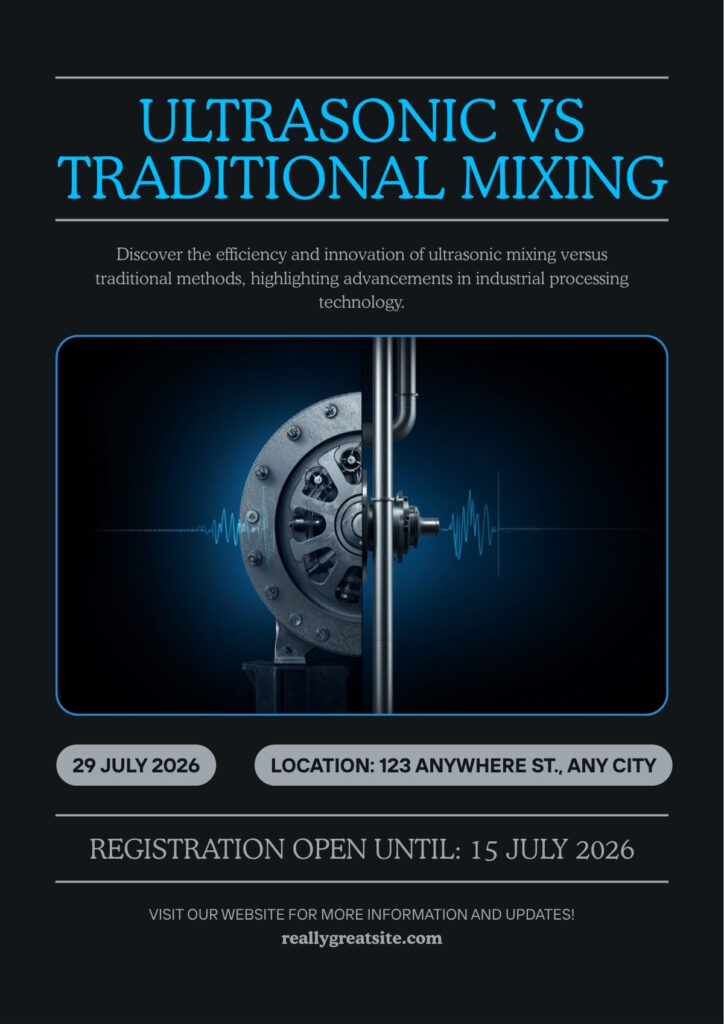
Ball mills, basket mills, heated agitators, high-shear mixers — for decades, these have been the default tools for blending and dispersing industrial fluids. They work, but they are slow, energy-hungry, and full of moving parts that wear out. Ultrasonic tubular processors are changing that calculus, and manufacturers are taking notice.
How Traditional Mixing Falls Short
Conventional mechanical processing relies on physical contact — blades, media, gears — to break down particles and blend fluids. That approach has real limitations:
- Heat build-up from friction, which can degrade sensitive formulations and requires cooling cycles
- Slow throughput — a basket mill can take 6–8 hours to produce a tonne of paint
- Wear and maintenance on blades, media and bearings, all of which are moving parts operating under constant load
- Inconsistent particle size, since mechanical shear does not always break material down evenly
How Ultrasonic Tubular Processing Compares
An ultrasonic tubular processor achieves the same end goals — mixing, dispersing, milling, emulsifying — through acoustic cavitation instead of mechanical contact. Sound waves travelling through the fluid create and collapse millions of microscopic bubbles, and that implosion energy does the work.
| Factor | Traditional Mixing | Ultrasonic Tubular Processing |
|---|---|---|
| Moving parts | Yes — blades, media, bearings | None |
| Heat generated | Significant | Minimal (“cold boiling”) |
| Typical paint production time (1 tonne) | 6–8 hours | ~32 minutes |
| Energy use | Baseline | Roughly 1/12th |
| Maintenance | Routine part replacement | Minimal, no wear parts |
Why the Switch Makes Financial Sense
The business case goes beyond speed. Lower energy consumption and reduced maintenance directly cut operating costs — one Hilsonic client has run all their white-based paint manufacturing on a single 1.5kW processor for over a year. Because there are no moving parts, cleaning media requirements drop too, and production line circuits can be cleaned faster between batches, meaning less downtime and faster changeovers.
There is also an environmental angle: lower energy use means fewer emissions, and in processes like paint manufacture and recovery, ultrasonic processing significantly reduces solvent and VOC emissions compared with mechanical milling.
When Traditional Mixing Still Makes Sense
Ultrasonic processing is not a universal replacement for every mixing application — very high-viscosity pastes or certain large-particle applications may still call for mechanical methods. But for lubricant blending, paint manufacture, fuel oil viscosity modification and fluid recycling, tubular processors now consistently outperform mechanical alternatives on speed, cost and consistency.
Talk to Hilsonic
Hilsonic has supplied ultrasonic processing equipment for more than 35 years through our British parent company, and we are the leading distributor of this technology in Nigeria. If you currently rely on ball mills, basket mills or heated agitation, contact us for a free, no-obligation comparison presentation, or read more about how ultrasonic cavitation works.